CHAPTER I
INTRODUCTION
Breast tumors often give the impression of scary, especially when found in women aged over 40 years. Even many of the oncologists argue that any tumor in the breast carcinoma, especially in women considered at high risk groups such as fibroadenoma, although benign tumors, dysplasia (fibrocystic, adenosis), mastitis and fat necrosis can not be ignored. This opinion is understandable, given the frequency of breast carcinomas are relatively high, giving rise to the problem health dala especially for women, not only in developed countries, but also in developing countries including Indonesia. The frequency of breast carcinoma in developed countries is the most that is the ratio of 5:1, compared with carcinoma of the cervix uteri, while in Indonesia ururtan neoplasms are located in the second after the cervix uteri karsinomaa.


CHAPTER II
Anatomy and Physiology
I. ANATOMY OF BREAST
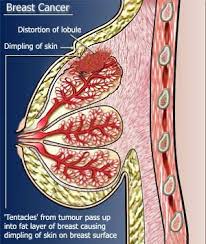
The stroma of breast masses and breast parenchyma located in the anterior wall of the piston between the ICS II and VI and parasternal line to axilaris medius. Breasts consist of alveoli, lactiferous duct, lactiferous sinus, ampulla, pore pailla, and alveola edge. The main vascularization of the breast have a branch. the internal mammary, a. torakoakromialis and a branch. Intercostal.
Breast lies on either side hemitoraks with limits as follows:
A. Boundaries of the breast that looks from the outside:
a. Superior: ribs II or III
b. Inferior: VI or VII ribs
c. Medial: the edge of the sternum
d. Lateral: anterior axillary line
2. The boundaries of real breasts:
a. Superior: almost to the clavicle
b. Medial: midline
c. Lateral: m. latissimus dorsi
INTRODUCTION
Breast tumors often give the impression of scary, especially when found in women aged over 40 years. Even many of the oncologists argue that any tumor in the breast carcinoma, especially in women considered at high risk groups such as fibroadenoma, although benign tumors, dysplasia (fibrocystic, adenosis), mastitis and fat necrosis can not be ignored. This opinion is understandable, given the frequency of breast carcinomas are relatively high, giving rise to the problem health dala especially for women, not only in developed countries, but also in developing countries including Indonesia. The frequency of breast carcinoma in developed countries is the most that is the ratio of 5:1, compared with carcinoma of the cervix uteri, while in Indonesia ururtan neoplasms are located in the second after the cervix uteri karsinomaa.
CHAPTER II
Anatomy and Physiology
I. ANATOMY OF BREAST
The stroma of breast masses and breast parenchyma located in the anterior wall of the piston between the ICS II and VI and parasternal line to axilaris medius. Breasts consist of alveoli, lactiferous duct, lactiferous sinus, ampulla, pore pailla, and alveola edge. The main vascularization of the breast have a branch. the internal mammary, a. torakoakromialis and a branch. Intercostal.
Breast lies on either side hemitoraks with limits as follows:
A. Boundaries of the breast that looks from the outside:
a. Superior: ribs II or III
b. Inferior: VI or VII ribs
c. Medial: the edge of the sternum
d. Lateral: anterior axillary line
2. The boundaries of real breasts:
a. Superior: almost to the clavicle
b. Medial: midline
c. Lateral: m. latissimus dorsi
