"A Man can't make a mistake can't make anything"
Showing posts with label GENDER. Show all posts

Saturday, 14 April 2012

BLADDER STONE OR VESICOLITHIASIS (DEFINITION, ETIOLOGY,DIAGNOSIS AND MANAGEMENT, BATU BULI BULI / KANDUNG KENCING DIAGNOSA DAN PENATALAKSANAANNYA


CHAPTER I
INTRODUCTION

A. DEFINITION
Urolithiasis is a disease that is symptomatic of the formation of stones in the urinary tract. Suspected urinary tract stone formation related to urine flow disorders, metabolic disorders, urinary tract infection, dehydration, and other circumstances that remain unclear (idiopathic).
Epidemiologically, there are several factors that facilitate the occurrence of urinary tract stones at someone. These factors are intrinsic factor which is the state that comes from one's body and extrinsic factors that influence comes from the surrounding environment.

Intrinsic factors such as:
A. Hereditary (hereditary). The disease is thought to be derived from his parents.
2. Age. The disease is most often obtained at the age of 30-50 years.
3. Gender. The number of male patients are three times more than the number of female patients.
Several extrinsic factors such as:
A. Geography. In some areas show the incidence of urinary tract stones are higher than other areas and became known as the stone belt (belt rocks), while the Bantu in South Africa found almost no urinary tract stone disease.

Wednesday, 11 April 2012

TERATOMA AND DERMOID CYST, DEFINITION, SIGN, SYMPTOMS, ETIOLOGY, DIAGNOSIS AND MANAGEMENT


CHAPTER I
INTRODUCTION

I. 1 OVERVIEW
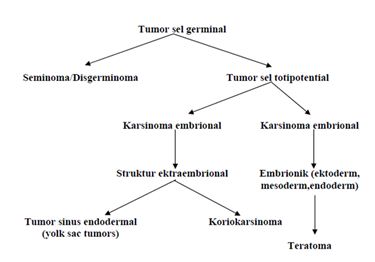
Teratomas are germ cell tumors are generally composed of multiple cell types derived from one or more of the three germ layers of endoderm, mesoderm and ectoderm. Inconsistent nomenclature is often confused about the various subtypes of teratoma. Teratomas derived from the Greek meaning of the terrace monster, which was first described by Virchow in the first edition of his book published in 1863. Teratoma is divided into three categories: mature teratoma (benign), immature teratoma and teratoma with differentiation monodermal particular degrees depending on the quantity of immature tissue showed the potential for malignancy. Cystic teratomas are generally benign and malignant solid is. Teratomas vary from a benign form of the cystic lesions of well differentiated (mature) to form a solid and malignant (immature). Immature teratomas are malignant germ cell tumor to the three most common after disgerminoma and endodermal sinus tumor. In addition, there also have a specific component (usually squamous) who experienced malignant transformation, but are rarely found.

In 1831, Leblanc created the term dermoid cyst in the literature of veterinary medicine when he succeeded in removing skin lesions at the base of the skull resembles a horse. Both teratomas and dermoid, a term still used and are often used interchangeably. Implications of these elements behawa beginning to resemble the skin with a complementary structure composed of dermoid, whereas teratoma has no such limit. Dermoid now known as the trigeminal and contain various types of tissue.